Surprising stat: an exchange can hold over 95% of assets in offline cold storage and still lose customers to simple login errors. That contrast — strong institutional security on one side, fragile human and protocol edges on the other — is the practical tension every US trader faces when they attempt an OKX sign in or set up an OKX account for the first time. This piece walks through a specific, realistic case of a US-based trader who wants fast access to spot markets, margin positions, and Web3 dApps, and uses that scenario to unpack how OKX’s login and Web3 features actually work, where they break, and what to watch for next.
We’ll move from mechanism to trade-offs: the mechanics of KYC, two-factor authentication, and the self-custodial wallet; the trade-offs of centralized custody versus non-custodial Web3 interactions; and the boundary conditions — when a feature helps and when it creates new risks. The aim is operational: after reading you should be able to complete an OKX sign in with clearer mental models about security, recovery, and when to use the exchange’s Web3 wallet versus your own hardware device.
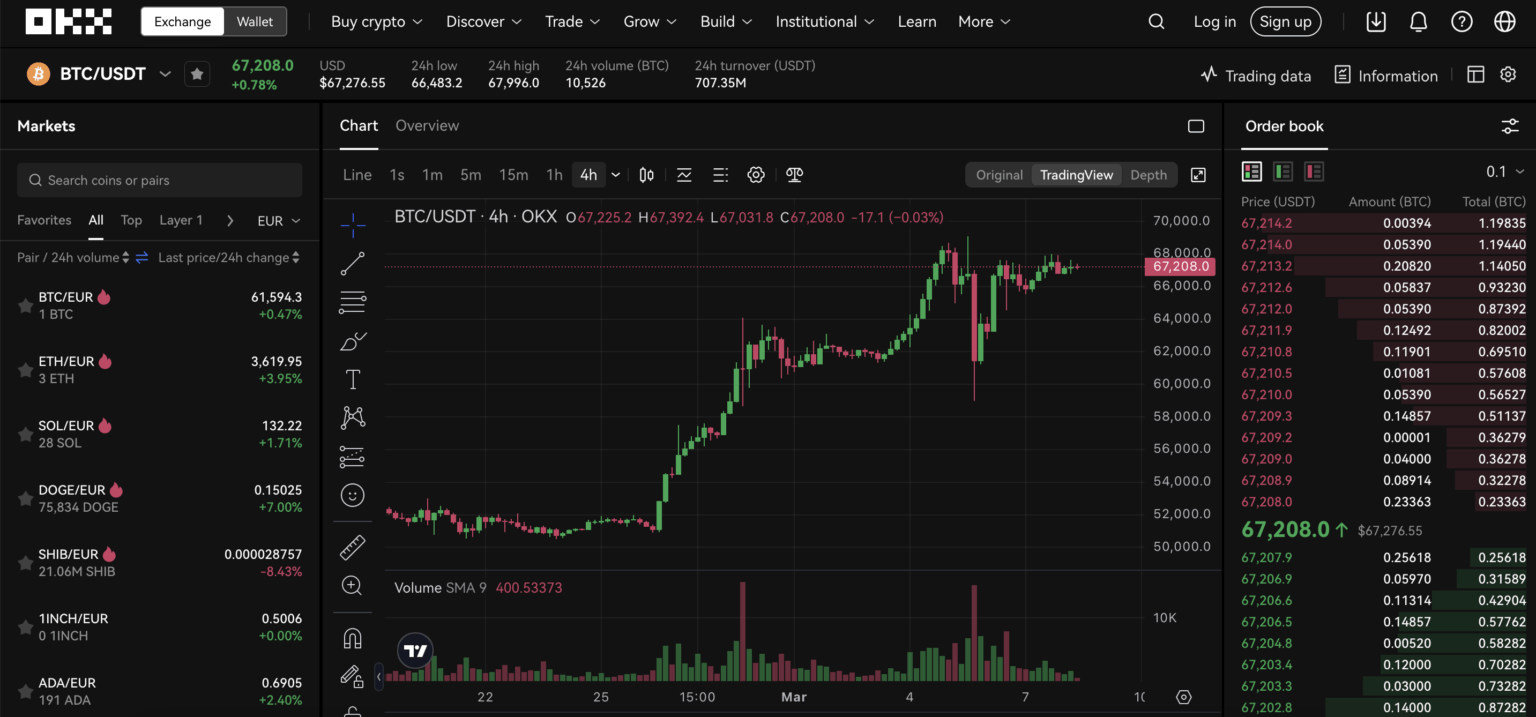
The case: a US trader opening OKX, logging in, and bridging to DeFi
Meet a representative case: Jenna, a US-based active trader, wants to move BTC from an external wallet into OKX, stake some ETH, trade a handful of altcoins on spot, and occasionally use the OKX Web3 wallet to interact with a Solana NFT mint. What happens step-by-step when she signs in matters more than marketing lines. First: account creation requires KYC — a government ID and a liveness facial check. That KYC is not just bureaucracy; it enables fiat rails and derivatives access but also imposes regulatory exposure. In the US context, KYC means Jenna’s account actions are traceable in ways that don’t apply to non-KYC wallets.
Next, Jenna enables mandatory two-factor authentication (2FA). OKX supports SMS, Google Authenticator, and biometrics. The platform layers AI-driven real-time threat detection to monitor suspicious logins. Practically, that combination reduces remote takeover risk but creates operational failure modes: losing a phone or suspending an authenticator app can temporarily lock a user out. Jenna must therefore understand OKX’s recovery paths and the distinction between centralized account recovery and irrecoverable self-custodial keys.
Mechanics: how OKX login, account protection, and Web3 wallet interact
Mechanism matters because the system is hybrid: OKX operates a centralized exchange (CEX) while offering a non-custodial Web3 wallet. The CEX side stores over 95% of user assets in offline, multi-signature cold wallets — a strong institutional control that mitigates large-scale hot-wallet hacks. But when Jenna uses the OKX Web3 wallet she can opt to hold private keys herself via a seed phrase or connect a Ledger/Trezor. That creates a clear fork: custodial security (recoverable by the exchange under KYC and recovery procedures) versus self-custody security (recoverable only via the seed phrase and hardware backups).
Operational implication: use the OKX custodial account for fast trading, margin, and derivatives where the exchange’s PoR (Proof of Reserves) and cold storage provide measurable assurances. Use the non-custodial Web3 wallet when interacting with DApps where custody of private keys is essential to participation, but accept the trade-off that losing the seed phrase is permanent. If Jenna plans to stake or yield-farm through OKX’s centralized staking, the custody model works differently than when she connects her non-custodial wallet to a third-party DeFi protocol.
Where the login process breaks and how to guard against it
There are several common failure modes that are easy to underestimate. One is phishing: attackers mimic OKX sign in screens or push fake browser-extension prompts. Even with AI detection on the backend, phishing succeeds mainly by tricking the user. Second is 2FA failure: SMS-based 2FA is convenient but vulnerable to SIM swap attacks; app-based authenticators are safer but can be lost if not backed up. Third is regulatory friction: for US residents, KYC may trigger account holds when IDs mismatch or when transaction patterns trigger enhanced review. These holds can prevent access to funds temporarily even if the platform’s cold storage is secure.
Practical mitigations: prefer an authenticator app or hardware security keys (FIDO2) where OKX supports them; maintain a secure offline backup of any seed phrase if opting for the Web3 wallet; and prepare identity documents in the format OKX requests to minimize verification delays. For high-volume traders, segregate capital: keep day-trading funds on the custodial account for liquidity and speed, and store long-term holdings in a hardware wallet you control. That mental model helps reconcile speed with survivability.
A non-obvious insight: delistings are signal, not panic
Recently OKX delisted several spot trading pairs (RSS3, MemeFi, GHST, RIO, SWEAT). Traders often read delistings as immediate red flags about platform stability. But mechanistically, delistings are routine risk management: exchanges drop low-volume or high-risk pairs to reduce operational and compliance overhead. For Jenna, the practical takeaway is to monitor liquidity and listings rather than treat any single delisting as collapse evidence. Still, delistings can affect portfolio strategies: if you hold niche tokens, a delisting increases withdrawal friction and slippage risk, and may force an off-exchange custody move.
Decision heuristic: treat delistings as a liquidity signal. If a token you hold is delisted, evaluate alternatives on speed to withdraw, projected slippage, and whether the token trades elsewhere in the US. If not, consider using a DEX aggregator or non-custodial channels — but remember those introduce smart-contract exposure and possible cross-chain bridge risks.
Trade-offs: custody, convenience, and composability
OKX combines centralized exchange features with a DEX aggregator and a Web3 wallet. That creates valuable composability — a single lane to trade, stake, and engage with NFTs — but at a cost. Centralized custody buys convenience and regulatory certainty; self-custody buys control and fewer third-party dependencies. The non-custodial Web3 wallet is powerful for DApp interactions and supports hardware wallets, yet using it pushes responsibility onto the user for seed phrase security. The trade-off is stark: convenience can be revoked by regulatory or security holds; control can be irrevocably lost by a misplaced seed phrase.
For US traders: if your strategy depends on fast access to margin and futures, prioritize the custodial account with strong 2FA and withdrawal whitelists. If your strategy involves yield farming across multiple chains, favor a hardware-backed Web3 wallet and use OKX’s DEX aggregator only for routing when necessary. These are not binary choices; diversify across both custody models depending on the exposure each position requires.
What to watch next — conditional scenarios
Three conditional scenarios matter for near-term vigilance. One: tighter US regulatory scrutiny could increase KYC friction and product availability for US accounts; the signaling mechanism would be slower KYC approvals and more delistings. Two: improvements in PoR transparency or new on-chain accounting could strengthen institutional trust; watch for enhanced public auditing tools. Three: cross-chain bridge incidents or smart-contract exploits may push traders back to custodial venues temporarily; pay attention to developer patching cadence and insurance pools. None of these are certainties — treat them as plausible outcomes tied to observable policy, audit, and incident signals.
If you want practical step-by-step guidance for the OKX sign in process and initial setup that aligns with the mechanics discussed above, you can find a concise walkthrough linked here.
FAQ
Q: If I lose my phone with OKX 2FA, how do I regain access?
A: The recovery path depends on the 2FA method. If you used an authenticator app, you need the recovery codes you saved during setup or access to a backup device. If you used SMS and lose the SIM, contact your mobile carrier to recover the number and then OKX support for account recovery; expect identity verification and delays. For non-custodial Web3 wallets, there is no account recovery without the seed phrase. Prepare recovery options before a loss occurs.
Q: Should I use OKX’s non-custodial wallet or keep everything on the exchange?
A: Use both according to purpose. Keep trading capital and margin-ready assets on the custodial exchange for speed and liquidity. Use a non-custodial wallet (ideally hardware-backed) for long-term holdings, NFT minting, and DeFi interactions where you must control keys. This hybrid strategy balances convenience, counterparty risk, and self-sovereignty.
Q: What does Proof of Reserves (PoR) actually guarantee?
A: PoR provides on-chain evidence that the exchange’s declared reserves match user liabilities at a snapshot. It increases transparency but doesn’t eliminate operational risks (like restricted withdrawals during legal action) nor does it guarantee immunity from future insolvency. Treat PoR as one signal among several, not a sole guarantee.
Q: How do delistings affect me as a trader in the US?
A: Delistings reduce the liquidity and ease of exiting positions on that exchange. If a token you hold is delisted, you may need to withdraw it to another venue or use a DEX, which brings additional slippage and smart-contract risks. Monitor delisting announcements and act early if you hold thinly traded assets.